
MtoZ Biolabs has launched the electrochemiluminescence (ECL) assay service which enables precise and quantitative analysis of the expression levels of specific target proteins. This service is suitable for targeted proteomics research and is widely applied in biomarker validation and protein expression analysis, providing strong support for obtaining reliable quantitative data on target proteins.
What Is Electrochemiluminescence (ECL)?
Electrochemiluminescence (ECL) is a highly sensitive detection technology that combines electrochemical reactions with chemiluminescent signals. By triggering labeled luminophores on the electrode surface to generate controlled light signals, ECL enables accurate quantitative analysis of target proteins. Its core principle is to electrochemically excite luminescent probes and correlate the emitted light intensity with the abundance of target molecules, offering advantages such as low background noise and a wide dynamic range. ECL is particularly important in targeted protein detection, as it allows stable and accurate measurement of trace protein changes and provides reliable support for highly specific biological analyses.
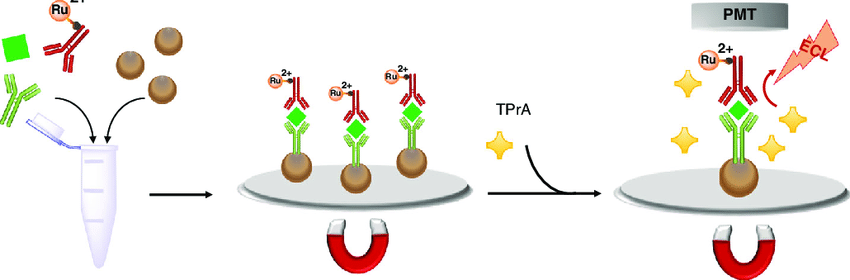
Zanut, A. et al. Nature Communications, 2020.
Figure 1. Schematic Representation of the Electrochemiluminescence (ECL) Immunoassay (Sandwich Assay).
Electrochemiluminescence (ECL) Assay Service at MtoZ Biolabs
MtoZ Biolabs uses ECL technology to provide high-sensitivity, high-specificity targeted protein detection services, enabling accurate measurement of target protein abundance and dynamic changes.
-
Quantitative measurement of expression levels of specific target proteins
-
Evaluation of protein concentration differences across sample groups
-
Analysis of the effects of different conditions on target proteins
-
Support for simultaneous assessment of multiple analytes
Our analysis delivers a systematic understanding of targeted protein expression patterns, allowing researchers to efficiently obtain key biological insights and advance their studies.
Workflow of Electrochemiluminescence (ECL) Assay Service
1. Sample Preparation
Perform quality control and aliquoting of experimental samples to ensure they meet ECL detection requirements.
2. Target Antibody Binding
Bind electrochemiluminescently labeled antibodies to target proteins with high specificity to form stable detection complexes.
3. Electrochemiluminescence Reaction
Trigger the luminescent reaction on the electrode surface, where electrochemical excitation generates detectable light signals.
4. Signal Acquisition and Reading
Use high-sensitivity instruments to record the emitted light intensity and convert it into quantitative data correlated with protein abundance.
5. Data Analysis and Reporting
Conduct signal correction, standard curve fitting, and quantitative analysis, followed by generation of graphical outputs and a summary report.
Why Choose MtoZ Biolabs?
- High Sensitivity Detection: Accurately quantifies low-abundance target proteins even in complex sample backgrounds.
- Wide Dynamic Range: Covers both high and low protein concentrations, supporting diverse research needs.
- Strong Signal Stability: Electrochemical excitation minimizes photobleaching and background noise, ensuring reliable data.
- High Specificity: Antibody-based recognition reduces nonspecific binding and enhances detection accuracy.
- End-to-End Analytical Support: Provides a complete workflow from experimental measurement to data interpretation.
Applications of Electrochemiluminescence (ECL) Assay Service
1. Biomarker Screening and Verification
Through stable and reproducible protein expression measurements, this supports the preliminary screening, verification, and model development of biomarkers, providing a foundation for subsequent application studies.
2. Cell Signaling Pathway Research
Used to monitor changes in key proteins and regulatory nodes within signaling pathways, helping to elucidate activation states, regulatory direction, and molecular mechanisms.
3. Functional Mechanism Exploration
By detecting the expression of function-related proteins, this assists in revealing molecular mechanisms, regulatory pathways, and key influencing factors.
4. Protein Network and Interaction Studies
By measuring expression changes of multiple proteins, this supports the construction of regulatory networks and correlation analyses, enabling research on complex biological systems.
5. Metabolism-Related Protein Measurement
Used to detect expression changes in metabolic regulatory proteins, supporting pathway analysis, energy metabolism studies, and physiological state assessment.
Deliverables
- Comprehensive Experimental Details
- Materials, Instruments, and Methods
- Quantitative Results of Target Proteins
- Visualization Chart Files
- Raw Data Files
- Comprehensive Analysis Report
FAQ
Q1: What types of samples are suitable?
A1: Electrochemiluminescence (ECL) Assay Service is suitable for biological samples with clear origin, stable quality, and good solubility, including serum, plasma, cell culture supernatant, tissue homogenates, and other samples containing detectable target proteins. Samples should be free of contamination or degradation to ensure stable signal output and reliable results.
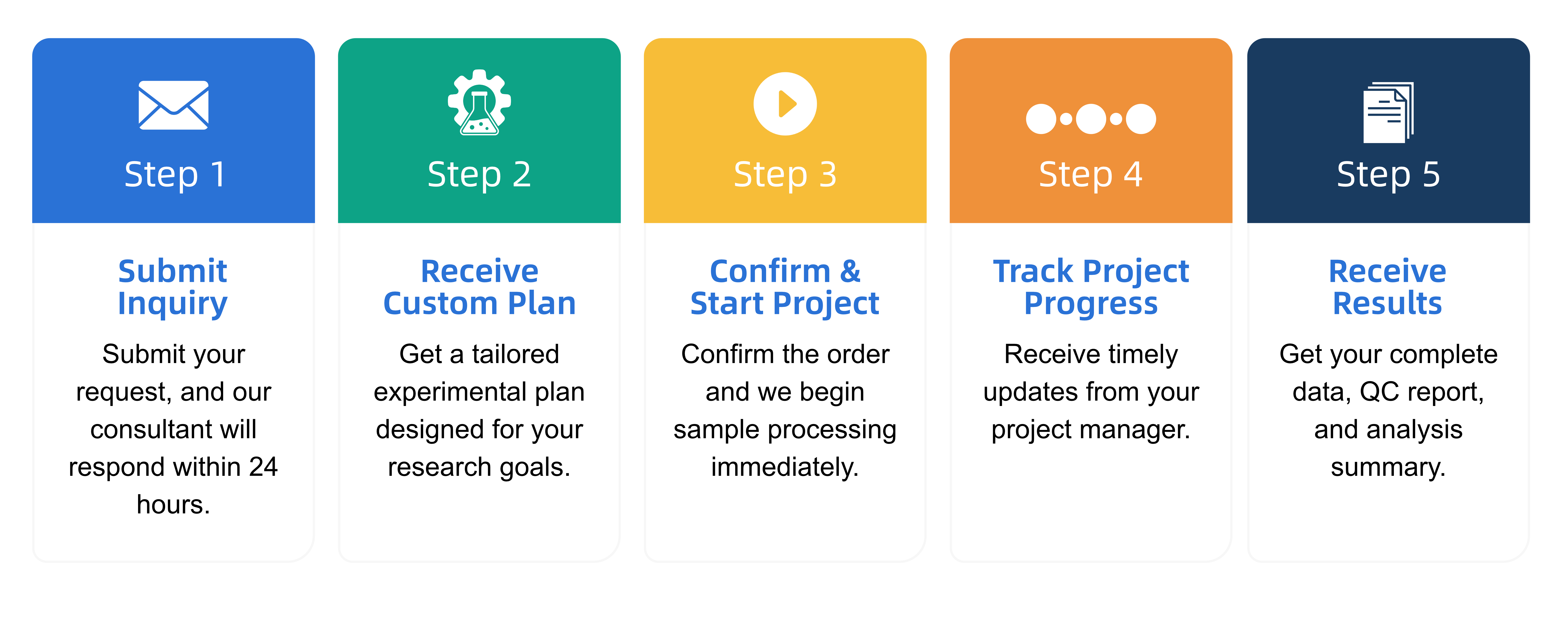
Q2: What is the service general workflow?
A2:
Q3: What data formats are provided?
A3: MtoZ Biolabs will provide multiple standardized output formats, including:
- Protein quantification data (Excel/CSV)
- Analysis report PDF (including experimental methods, quality control, and data interpretation)
- Visualization chart files (such as standard curves and expression bar charts, PNG/TIFF)
- Raw data files (for further analysis)
If special analytical requirements exist, data formats can be customized according to project specifications.
Q4: How should I prepare my samples?
A4: To ensure optimal detection performance, it is recommended to prepare samples as follows:
- Sample Purity: Samples should remain clean, free of particulate matter, and without significant matrix interference.
- Sample Storage: Store at 4℃ for short-term use; for long-term storage, place at -80℃ and avoid repeated freeze-thaw cycles.
- Sample Transport: Use sealed containers and maintain low temperatures during transport to prevent degradation.
- Additional Information: Provide sample type, processing steps, concentration, and experimental background to enable selection of the most appropriate detection scheme.
For more information, please refer to Sample Submission Guidelines for Proteomics, Sample Submission Guidelines for Metabolomics.
Start Your Project with MtoZ Biolabs
Contact us to discuss your experimental design or request a quote. Whether you are exploring expression changes of key proteins or investigating specific signal responses in complex systems, we can provide you with precise and reliable ECL detection support.