
MtoZ Biolabs provides In-Depth Nasal Secretions Proteomic Solutions that perform systematic protein identification and quantitative proteomic profiling from nasal secretions, supporting high-confidence biomarker discovery and clinical proteome research.
Background
Nasal secretions are a complex biological fluid composed of proteins, peptides, glycoproteins, and immune-related molecules that play a fundamental role in respiratory defense. As the primary interface between the host and the external environment, nasal fluid forms the first biological barrier against pathogens, allergens, and airborne irritants. The protein composition within nasal fluid is highly dynamic and mirrors localized inflammatory signals as well as broader systemic immune status. Profiling this proteome helps researchers decode mucosal immune behaviors, identify infection- or allergy-associated protein shifts, and uncover biomarkers linked to airway and respiratory conditions.
Proteomic interrogation of nasal secretions has expanded rapidly as a valuable strategy for detecting molecular patterns associated with respiratory diseases, infections, and allergic phenotypes. Distinct protein signatures identified in nasal fluid have been correlated with chronic rhinosinusitis (CRS), asthma, allergic rhinitis, viral infections such as influenza, as well as inflammatory airway pathologies triggered by environmental stressors. Surveillance of nasal proteins also supports studies focused on early molecular indicators of disease onset, therapeutic response variation, and real-world heterogeneity between disease subtypes.
In-Depth Nasal Secretions Proteomic Solutions at MtoZ Biolabs
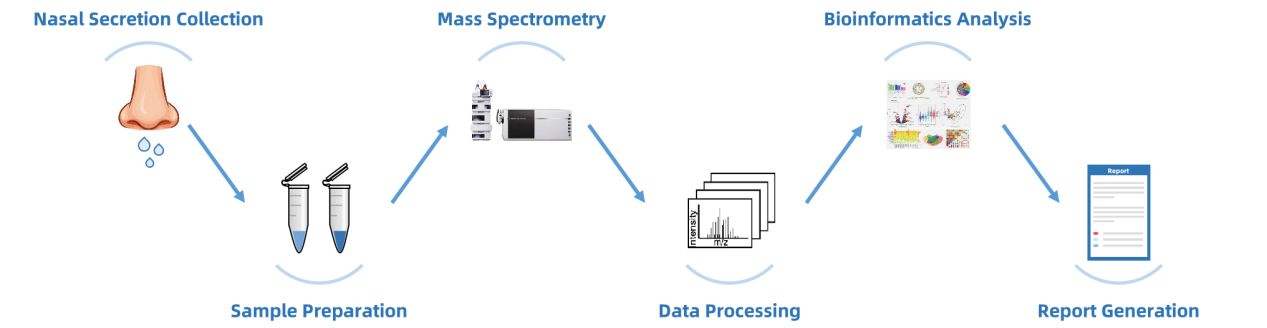
MtoZ Biolabs offers In-Depth Nasal Secretions Proteomic Solutions using DIA for deep, unbiased, high-throughput protein detection while supporting both targeted protein panels for precise quantification and discovery-level proteome mapping. The workflow is optimized for challenging nasal fluid matrices through standardized extraction, digestion, high-resolution LC-MS/MS acquisition, and summarized bioinformatics interpretation including key checks for data quality, differential protein signals, functional annotation, enrichment insights, and interaction mapping.
MtoZ Biolabs returns a confident protein identity list and quantitative matrices suited for biomarker studies and clinical proteome research. To maximize project simplicity You only need to submit your samples, and we manage every stage including extraction, digestion, LC-MS acquisition, data processing, and interpretation.
Why Choose MtoZ Biolabs
- High-resolution instruments and validated QC pipelines deliver precise protein identification and site-level confidence.
- DIA-powered acquisition ensures rapid, scalable analysis for nasal secretion matrices.
- Panel design, PTM options, replicates, and study depth are tailored to specific research goals.
- Seasoned proteomics scientists guide project planning and ensure reliable interpretation.
- Client-focused support enables smooth coordination, planning, and delivery.
Applications of In-Depth Nasal Secretions Proteomic Solutions
1. Airway Disease Biomarker Discovery
Nasal proteomics identifies protein programs relevant to chronic rhinosinusitis, asthma, cystic fibrosis, allergic rhinitis, and related airway disorders, supporting early detection and progression monitoring.
2. Host-Pathogen Induced Protein Shifts
Protein profiling reveals host-response signals associated with viral or bacterial infections from nasal secretion matrices, aiding mucosal immunity and defense mechanism studies.
3. Mucosal Immune and Inflammatory Signals
Nasal fluid analysis captures localized immune, inflammatory, epithelial defense, and stress-response proteins, compatible with summarized PTM-aware interpretation for mechanism research.
4. Therapeutic Response From Nasal Fluid
Monitoring summarized differential protein signals supports efficacy and target engagement interpretation for anti-inflammatory or immunotherapy research.
5. Molecular Readouts of Environmental Mucosal Stress
Proteome-level nasal secretion analysis characterizes host protein adjustments triggered by airborne allergens, irritants, or pollutants for exposure-associated research.
FAQ
Q1: What types of samples are suitable?
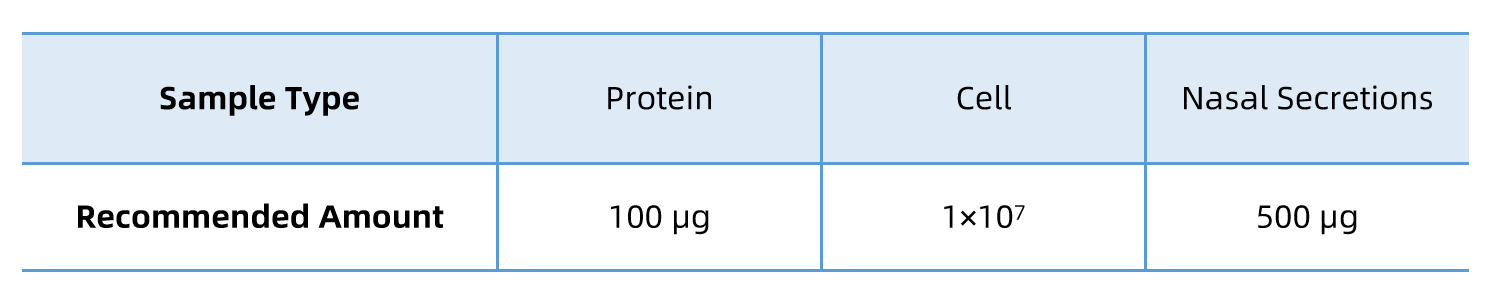
Purified protein, cultured cells, and frozen or freshly collected Nasal Secretions samples are suitable for analysis.
Q2: How should I prepare my samples?
- Ensure samples are freshly prepared or snap-frozen.
- Avoid detergents, salts, and reducing agents that may interfere with LC-MS/MS analysis.
- Store samples at –80 °C before shipment.
- Transport samples on dry ice to maintain stability during delivery.
Detailed requirements and recommendations can be found in the Sample Submission Guidelines for Proteomics.
Q3: What is the service general workflow?

Q4: What data formats are provided?
- Raw mass spectrometry acquisition files (.raw, .d, .wiff, .dia or run-specific output streams).
- Quantification and annotation-ready result tables provided in .xlsx or .csv, including protein intensity and key statistical or database-derived scores.
- Bioinformatics analysis summaries delivered in .xlsx or .csv, covering pathway, functional, or network-level readouts.
- Publication-ready figures exported as high-resolution .png or .tiff.
- A complete PDF report summarizing methods and QC metrics.
- Additional file formats available upon request.
Start Your Project with MtoZ Biolabs
Contact us to discuss your experimental design or request a quote. Our technical specialists are available to provide a free business assessment.