
MtoZ Biolabs offers specialized FFPE Tissue Proteomics Services that allow for high-resolution protein analysis from archived samples. Our advanced mass spectrometry workflows are designed to overcome the unique challenges of working with FFPE tissues, providing valuable proteomic insights for a wide range of research applications including disease studies, animal biology, plant sciences, microbiology, and more.
What Is FFPE Tissue Proteomics?
FFPE (Formalin-Fixed Paraffin-Embedded) tissue samples are widely used in clinical research and diagnostics because they preserve tissue architecture and biomolecule integrity for long periods. However, formalin induced cross linking and paraffin embedding make protein extraction and digestion more difficult, which can compromise proteomic data quality if not properly addressed.
FFPE tissue proteomics refers to the qualitative and quantitative analysis of proteins extracted from FFPE sections using LC-MS/MS based workflows. Unlike DNA or RNA based approaches, FFPE tissue proteomics measures the actual protein layer that executes cellular functions and reflects pathway activity, cell state, and microenvironmental changes. This allows researchers to obtain a functional proteome level view from archived human, animal, plant, or microbial tissues that are already routinely collected and stored in pathology and research settings.
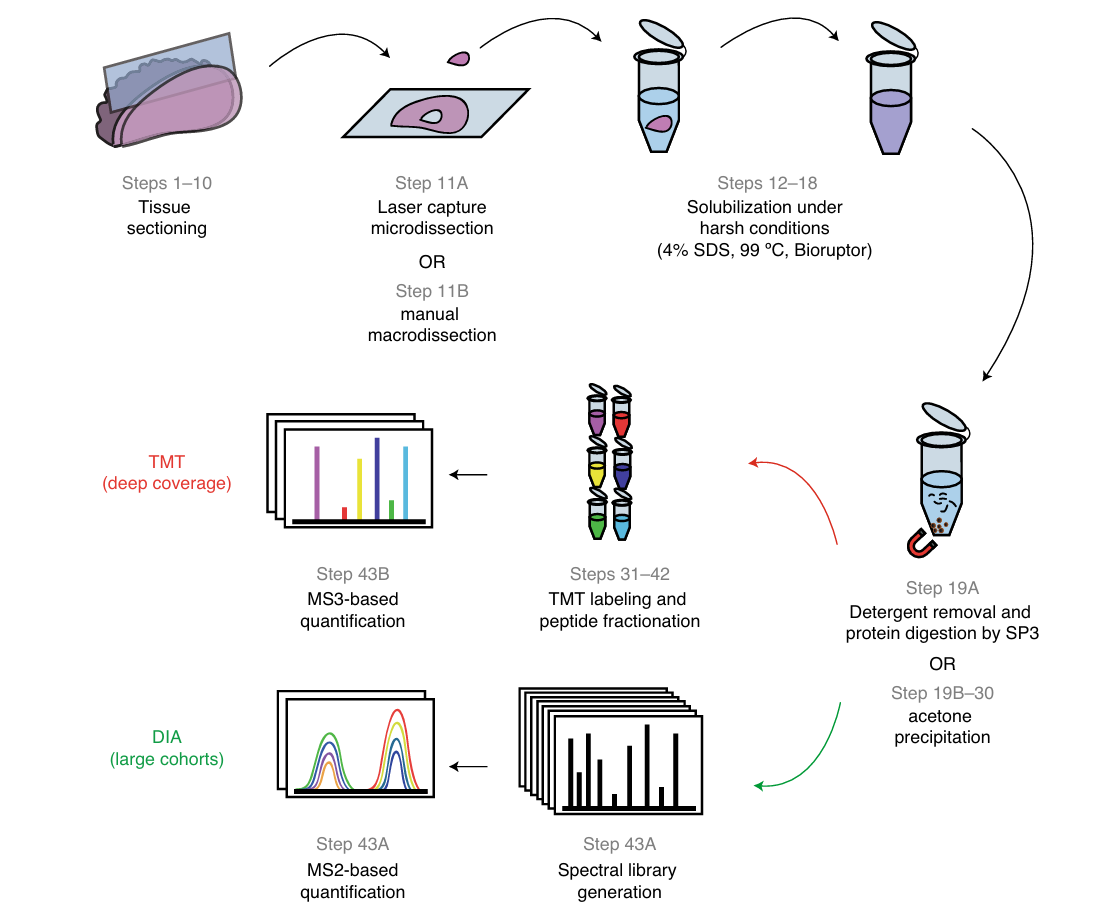
Buczak, K. et al. Nat Protoc. 2020.
Figure 1. Proteomic Analysis of Microdissected FFPE Specimens by Quantitative Mass Spectrometry
FFPE Tissue Proteomics Service at MtoZ Biolabs
MtoZ Biolabs' FFPE Tissue Proteomics Service enables the quantitative and qualitative analysis of proteins extracted from formalin fixed, paraffin embedded tissue sections using mass spectrometry based workflows. After deparaffinization and reversal of cross links, proteins are solubilized, digested into peptides, and analyzed by LC-MS/MS to determine their identities, relative abundances, and post translational modification states. This service captures the molecular composition and signaling status preserved in archived tissue, allowing detailed profiling of protein networks, pathway activity, and cell population characteristics at the proteome level.
Why Choose MtoZ Biolabs
1. Optimized for FFPE Samples
We specialize in overcoming the challenges of formalin fixation to provide high-quality, reproducible proteomic data from FFPE tissues.
2. High-Resolution Mass Spectrometry
Our state-of-the-art mass spectrometry platforms ensure precise protein identification and quantification, even from challenging FFPE samples.
3. Customizable Experimental Design
Our flexible service supports a wide range of experimental designs, from single-sample analysis to large cohort studies, across different tissue types.
4. End-to-End Service
MtoZ Biolabs handles every step of the process, from sample preparation to final report delivery, ensuring a seamless workflow and high-quality results.
Applications of FFPE Tissue Proteomics Service
1. Disease Mechanisms Research
FFPE proteomics reveals protein expression changes and pathway dysregulation in diseases like cancer, neurodegeneration, and metabolic disorders, helping uncover disease-driving mechanisms.
2. Drug Development
It aids in identifying therapeutic targets and evaluating drug effects on protein expression and post-translational modifications, advancing drug discovery and efficacy studies.
3. Biomarker Discovery and Validation
FFPE tissue proteomics helps identify and validate biomarkers for early disease detection, prognosis, and treatment response, supporting clinical applications.
4. Agricultural and Plant Research
In plant research, FFPE proteomics studies stress responses, disease resistance, and growth regulation, helping improve crop resilience and productivity.
5. Microbial Research
This service supports microbial studies by profiling proteins involved in host-pathogen interactions, virulence, and antimicrobial resistance, aiding infectious disease research.
FAQ
Q1: What types of samples are suitable?
- FFPE Slices: Thickness of 5-10 μm, size of 50 mm², with a minimum of 10 slices, to be transported at room temperature.
- Formalin-Fixed Tissue: Recommended sample weight is 30 mg, with long-term transport temperature maintained at 4°C, and not below 0°C.
Q2: How should I prepare my samples?
Clearly label tissue samples and provide a manifest with sample IDs, collection details, and metadata.
Detailed requirements and recommendations can be found in the Sample Submission Guidelines for Proteomics.
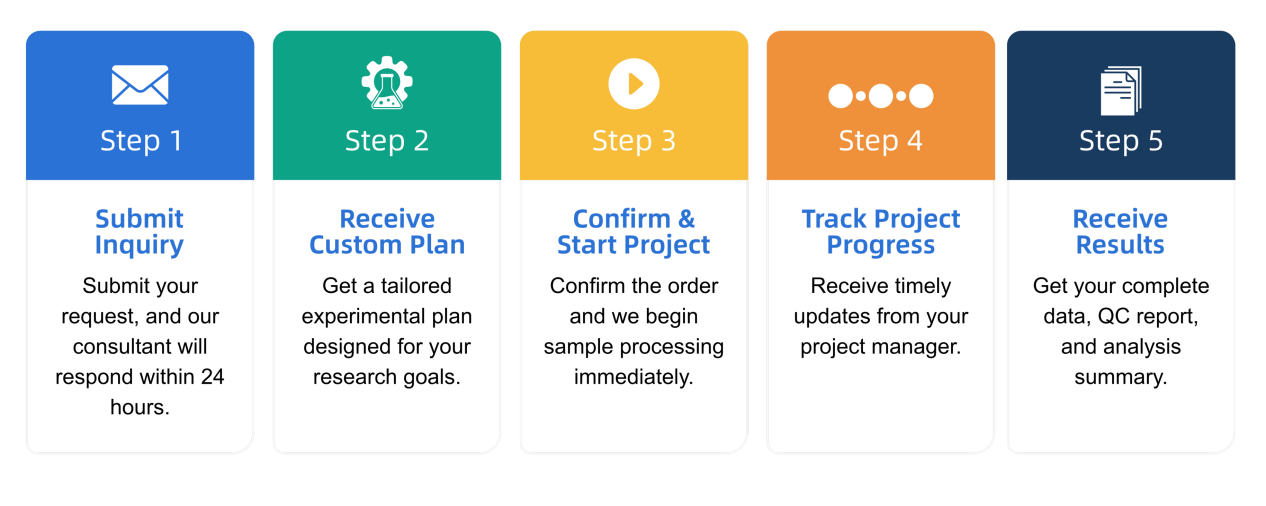
Q3: What is the service general workflow?
Q4: What data formats are provided?
- Raw Mass Spectrometry Data: Instrument-specific raw files (e.g., .raw, .wiff)
- Protein Identification and Quantification: Peptide and protein data in .xlsx or .csv format
- Statistical and Bioinformatics Outputs: Differential expression, pathway analysis, and functional annotations in spreadsheet formats
- Visualizations: High-resolution figures such as heatmaps, volcano plots, and PCA in .png or .tiff
- Project Report: A detailed PDF summary, including experimental methods, QC metrics, and biological interpretation
- Additional formats or customized deliverables can be provided upon request.
Start Your Project with MtoZ Biolabs
MtoZ Biolabs is ready to help you unlock the valuable proteomic information in your FFPE tissue samples. Whether you are investigating cancer mechanisms, biomarker discovery, or therapeutic targets, our FFPE Tissue Proteomics service is optimized for high-quality results from archival samples.
Contact us today to discuss your project, and let us help you turn your FFPE tissue samples into actionable data.