
MtoZ Biolabs provides Activity-Based Protein Profiling (ABPP) Service by applying a function-oriented analytical strategy that combines activity-based probes with LC-MS/MS to directly interrogate enzyme activity states and target engagement in complex biological systems, thereby enabling more reliable target identification and mechanistic studies.
Principle of Activity-Based Protein Profiling
Activity-Based Protein Profiling (ABPP) is a chemical proteomics approach that uses activity-based probes in combination with mass spectrometry to directly interrogate the functional state of enzymes. The core of ABPP is the activity-based probe, which typically consists of three integrated components.
The reactive group (warhead) is the central element of the probe and is designed to form a selective, usually covalent, bond with the enzyme active site. The chemical nature of the warhead defines the enzyme classes that can be profiled, such as serine hydrolases or cysteine proteases. The linker provides appropriate spatial flexibility and distance, allowing the warhead to access the active site while maintaining probe solubility and biological compatibility. The reporter group or clickable handle enables downstream enrichment, detection, and mass spectrometry-based identification.
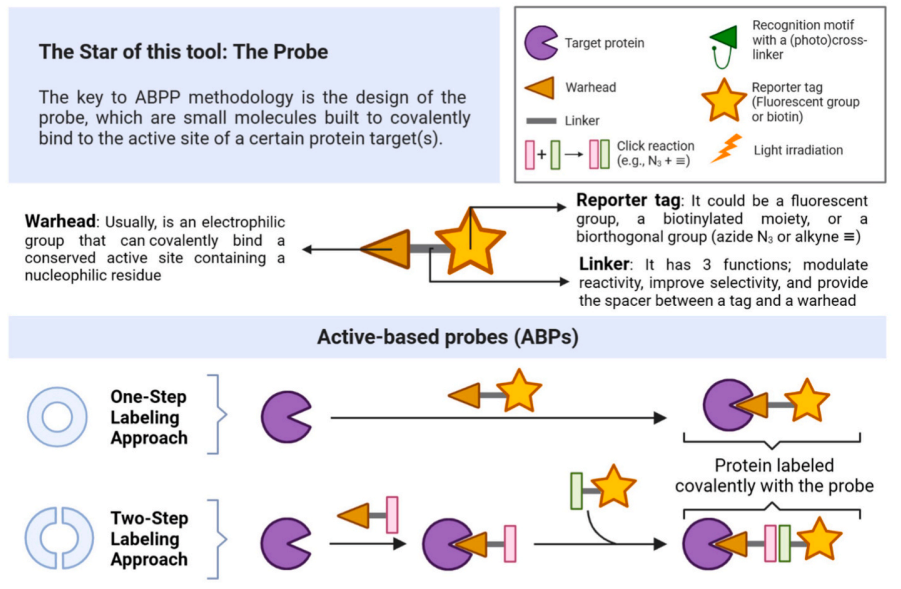
Porta, EOJ. et al. Curr Res Pharmacol Drug Discov. 2023.
Figure 1. The Composition of Probe
Among these components, the warhead determines whether ABPP truly reflects enzyme activity. Labeling occurs only when the enzyme adopts an active catalytic conformation with a reactive active site. Overly reactive warheads may cause nonspecific background, whereas insufficient reactivity can lead to incomplete labeling, requiring careful balance between selectivity and reaction efficiency. Because active-site microenvironments vary significantly across enzyme families, no universal probe exists, and ABPP typically relies on probe designs tailored to specific enzyme classes.
The working principle of ABPP can be summarized as “replacing antibody recognition with chemical reactivity, using the active site as the functional gatekeeper.” In practice, activity-based probes are introduced into near-physiological sample systems, where only enzymes that are in an active conformation and possess accessible, reactive active sites can undergo covalent labeling. The labeled proteins are then selectively recovered from complex proteomic backgrounds through affinity enrichment or click chemistry, followed by identification and relative quantification using LC-MS/MS.
Activity-Based Protein Profiling (ABPP) Service at MtoZ Biolabs
1. Competitive ABPP Service
By leveraging competition between small molecules and activity-based probes for active-site occupancy, this approach directly evaluates compound target engagement, selectivity, and potential off-target profiles in cells or complex biological systems. Competitive ABPP is one of the most widely used strategies for target identification and lead compound optimization.
2. Global / Discovery ABPP Service
Using family- or mechanism-biased activity probes, this service enables systematic labeling and mass spectrometry-based identification of active enzymes in a given sample, supporting activity enzyme landscape mapping and discovery of candidate functional enzymes.
3. Targeted ABPP and Validation Service
For known or strongly suspected targets or enzyme subfamilies, targeted ABPP experiments are performed to validate direct targets and compare activity changes under different treatment conditions.
4. ABPP Probe and Recognition Motif Design
- Reactive Group (Warhead) Design: MtoZ Biolabs optimizes warhead chemistries based on active-site features of target enzyme families to enable selective labeling under near-physiological conditions, including serine-, cysteine-, metal-dependent, and broad-spectrum reactive designs.
- Recognition Element Design: Recognition elements are designed using substrate preferences, known inhibitor features, or active-site pocket characteristics to achieve different levels of target or enzyme-family selectivity.
- Reporter Tag Design: MtoZ Biolabs provides flexible reporter tag and clickable module design, including affinity tags, fluorescent labels, click-chemistry handles, and MS-compatible formats to support downstream enrichment and LC-MS/MS analysis.
Workflow of Activity-Based Protein Profiling (ABPP) Service
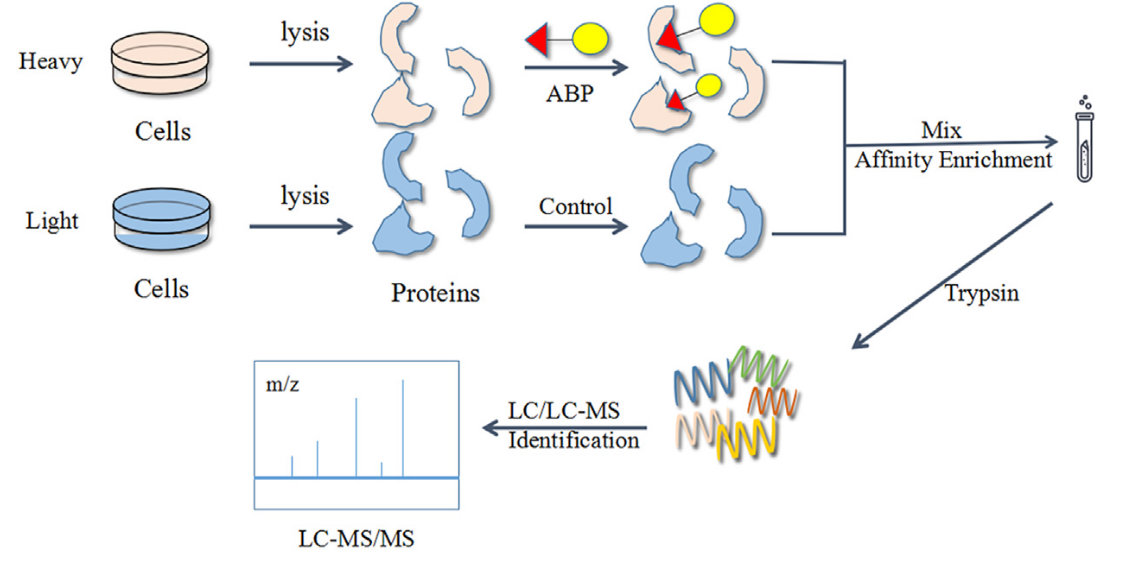
Li, G. et al. Front Chem. 2021.
Why Choose MtoZ Biolabs
1. Advanced Platform
MtoZ Biolabs has established a comprehensive ABPP analytical platform integrated with high-resolution LC-MS/MS systems, enabling stable detection and quantitative comparison of active enzymes in complex biological samples.
2. Extensive Experience
Our technical team has extensive experience in ABPP experimental design, competitive profiling, and MS-based target identification across multiple enzyme classes and research contexts, allowing rational optimization of study design and reduced trial-and-error.
3. One-Stop Solutions
We provide a complete, end-to-end service workflow from experimental design to data interpretation, minimizing coordination across platforms and ensuring efficient, traceable project execution.
4. Flexible Customization
Customized ABPP strategies are available based on research objectives and sample systems, including competitive or discovery ABPP selection, treatment condition and time-point design, probe selection, and analysis depth adjustment.
5. One-Time Charge
Our pricing is transparent, with no hidden fees or additional costs.
Start Your Project with MtoZ Biolabs
If you aim to systematically characterize direct targets, selectivity, and potential off-target risks of small molecules in physiologically relevant systems, contact MtoZ Biolabs. We will provide reliable, high-quality solutions based on a mature ABPP technology platform.
FAQs
Q1: What types of samples are suitable?
MtoZ Biolabs supports ABPP analysis in a variety of biological matrices, provided that enzyme activity can be reasonably preserved and is compatible with probe labeling. Common sample types include:
- Cell pellets or cultured cell lysates
- Animal or plant tissue lysates
- Subcellular fractions (e.g., cytosolic or membrane-enriched fractions)
- Purified proteins or enriched enzyme preparations
If suitability is uncertain, buffer composition and study objectives can be provided for feasibility evaluation.
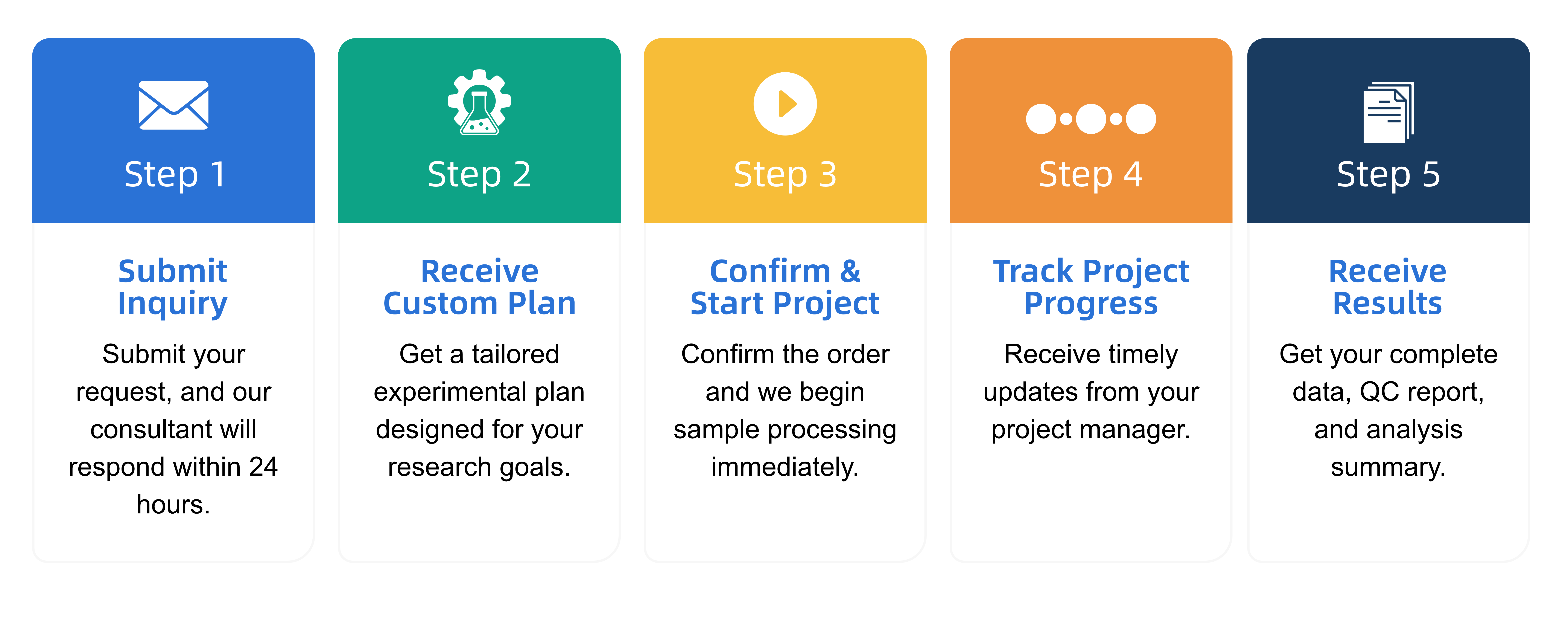
Q2: What is the service's general workflow of the service?
Q3: What data formats are provided?
MtoZ Biolabs delivers results in multiple standard formats to facilitate downstream analysis, visualization, and reporting, including:
- LC-MS/MS raw data files generated from ABPP analysis
- Processed identification and quantification tables (CSV or Excel) containing probe-labeled proteins or peptides with relative abundance information
- PDF summary reports outlining experimental design, key methods, quality control points, and major findings
- High-resolution image files (TIFF or PNG) for core result visualization and group comparisons
Customized data structures or additional file formats can be provided upon request to meet specific analysis or publication requirements.
Q4: How should I prepare my samples?
To ensure reliable ABPP results, MtoZ Biolabs recommends the following sample preparation guidelines:
1. Sample Type: Cell pellets, tissue samples, or clarified lysates are recommended. For lysates, please provide preparation details.
2. Buffer Compatibility: Avoid high concentrations of detergents, strong denaturants, or additives that may react with probes. If unavoidable, specify type and concentration for evaluation.
3. Sample Quality: Minimize particulate matter and excessive viscosity. Clarification by centrifugation is recommended for lysates.
4. Sample Amount: Provide sufficient material for analysis and control comparisons. If sample quantity is limited, reduced-scale workflows may be recommended.
5. Storage and Shipping: Store at −80°C and ship on dry ice using leak-proof packaging.
6. Documentation: Include sample origin, preparation methods, buffer composition, treatment conditions, and group design.
For more information, please refer to Sample Submission Guidelines for Proteomics and Sample Submission Guidelines for Metabolomics.