
MtoZ Biolabs provides the Spatial Proteomics Service by integrating spatial partitioning strategies with mass spectrometry-based proteomic analysis to systematically identify and quantify proteins within specific spatial regions of tissues or cells. This service enables researchers to characterize protein expression patterns and functional differences while preserving spatial context, providing reliable data support for mechanistic studies and biological interpretation.
Principle of Spatial Proteomics
Spatial proteomics is a class of proteomic strategies designed to preserve spatial information within tissues or cells during protein analysis. It focuses on addressing key questions such as where proteins are expressed, how protein composition varies across different spatial regions, and how these differences relate to tissue architecture or local microenvironments. Compared with bulk homogenization–based analyses, spatial proteomics links proteomic information to anatomical structures, pathological regions, or cell-enriched areas through spatial partitioning or in situ detection, making it particularly suitable for investigating tissue heterogeneity and region-specific biological processes.
One classical approach is region-based spatial proteomics. This strategy typically starts with tissue sections, where regions of interest are defined through histological staining or microscopic observation, followed by precise sampling using laser capture microdissection (LCM) or microregion-level cutting strategies, including fine fiber-level dissection. The spatially confined samples are then processed using conventional proteomics workflows and analyzed by liquid chromatography–tandem mass spectrometry (LC-MS/MS) for protein identification and quantification. This approach effectively combines spatial localization with high-coverage protein identification and quantitative analysis and is well suited for in-depth comparison of specific tissue regions.
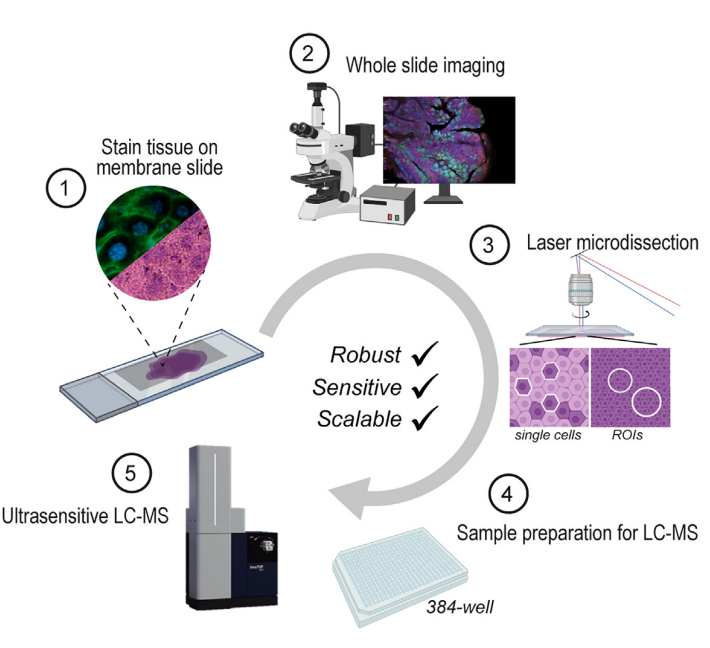
Makhmut, A. et al. Cell Syst. 2023.
Another major approach is mass spectrometry imaging (Mass Spectrometry Imaging, MSI), most commonly implemented using MALDI imaging. MSI acquires mass spectrometric signals through point-by-point scanning of tissue sections and maps the intensity of specific m/z ions back to spatial coordinates, directly generating molecular distribution maps within tissues. MSI emphasizes in situ visualization and spatial distribution trends and enables simultaneous observation of multiple molecular species without the need for antibody labeling. However, in-depth protein identification and rigorous quantification often require complementary LC-MS/MS analysis.
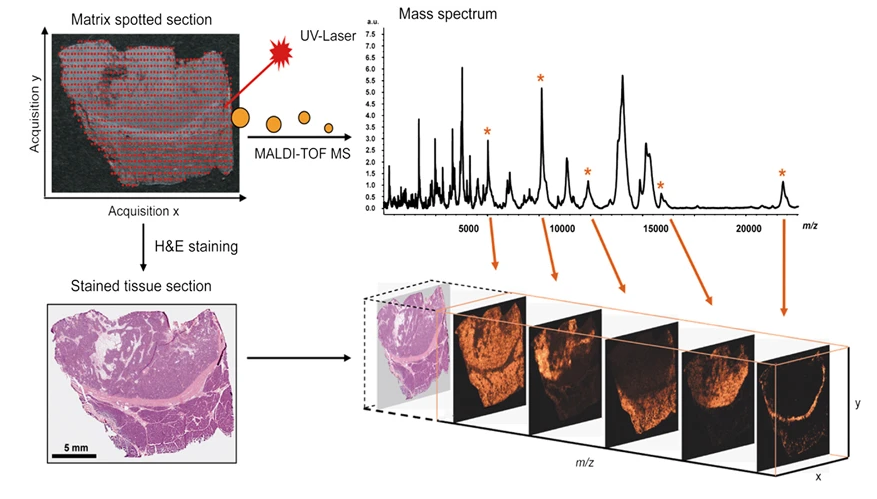
Aichler, M. et al. Lab Invest. 2015.
Figure 2. Principle of MALDI Imaging Mass Spectrometry
In addition to these approaches, spatial proteomics can also incorporate antibody-based spatial protein detection methods to provide more intuitive spatial expression readouts. Techniques such as multiplex immunofluorescence or imaging mass cytometry (IMC) enable protein expression mapping at the tissue scale and are well suited for multi-marker spatial comparison within predefined target panels. While these methods offer advantages in spatial resolution and throughput, their detection scope is typically limited by antibody availability or preset panels and therefore often complement discovery-driven, mass spectrometry–based analyses.
In practical research applications, spatial proteomics commonly employs multi-technology combinations to balance spatial resolution, proteome coverage, and interpretability. Typical strategies include using histological or immunostaining methods to define regions of interest, followed by LCM-based microdissection and LC-MS/MS for deep protein identification and quantification; using MSI to identify spatial distribution trends and subsequently performing targeted region dissection with LC-MS/MS for protein validation; or integrating antibody-based spatial phenotyping with LC-MS/MS proteomics data for joint interpretation. Through these approaches and combinations, spatial proteomics provides spatially contextualized protein evidence that supports comparative analysis and functional interpretation.
Spatial Proteomics Service at MtoZ Biolabs
1. Region-Based Spatial Proteomics Analysis
Specific regions within tissue sections are defined through histological evaluation and microscopic localization, followed by spatially confined sampling using laser capture microdissection (LCM) or microregion-level cutting strategies. LC-MS/MS analysis is then applied to systematically identify and relatively quantify proteins from different spatial regions, enabling comparison of protein expression across tissue compartments, pathological areas, or functional zones.
2. Mass Spectrometry Imaging–driven Spatial Protein Distribution Analysis
Mass spectrometry imaging is used to perform point-by-point scanning of tissue sections to generate spatial distribution maps of proteins or peptides. This approach supports the analysis of overall distribution patterns and region-specific signals and provides guidance for subsequent targeted spatial analyses.
3. Combined MSI and LC-MS/MS Analysis
Spatial distribution information obtained by MSI is integrated with LC-MS/MS–based proteomics from spatially dissected samples to enhance protein identification depth and quantitative reliability while preserving spatial information, enabling complementary validation of spatial trends and protein identities.
4. Spatial Protein-Protein Interaction Analysis by Proximity Labeling
MtoZ Biolabs integrates proximity labeling strategies to investigate protein–protein interactions within specific spatial regions or subcellular microenvironments. This approach enables in situ labeling of proteins in close proximity to a target protein or defined spatial structure, allowing neighboring proteins to be selectively modified and enriched. By preserving spatial or microenvironmental context, this strategy facilitates the systematic characterization of protein interaction networks associated with specific locations or functional niches.
5. Multiscale Spatial Protein Expression Profiling
Protein expression analysis can be performed at the tissue level, microregion level, or finer spatial scales, allowing researchers to systematically investigate spatial heterogeneity from global tissue architecture to localized regions.
Workflow of Spatial Proteomics Service
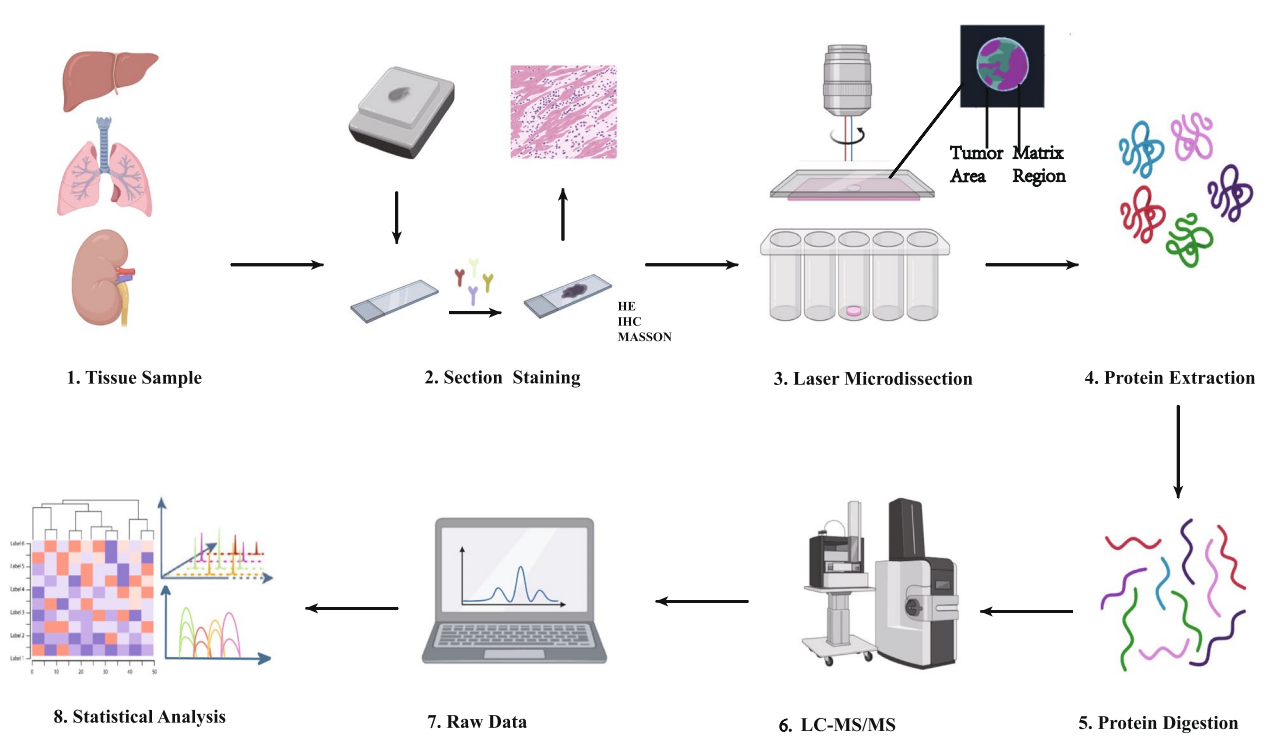
Wu, M. et al. Proteome Sci. 2024.
Why Choose MtoZ Biolabs
- Experience in projects combining proteomics with spatial analysis
- Support for multiple tissue types and diverse spatial partitioning strategies
- Mature mass spectrometry workflows with stable and reliable data output
- Clear service processes, efficient communication, and transparent pricing
Applications of Spatial Proteomics Service
- Comparative analysis of protein expression across different tissue regions
- Tumor microenvironment and tissue heterogeneity studies
- Spatially resolved protein changes during development
- Research on neural systems or structurally complex tissues
- Investigation of protein function and spatial regulatory mechanisms
Start Your Project with MtoZ Biolabs
Contact MtoZ Biolabs to discuss your sample types and research objectives with our technical team and advance your spatial proteomics research with reliable analytical support.
FAQs
Q1: What types of samples are suitable?
A1: This service is suitable for a wide range of tissue or cell samples, particularly those with clear spatial organization or region-specific analysis requirements. Specific sample types can be confirmed during project consultation.
Q2: What is the service's general workflow?

Q3: What data formats are provided?
MtoZ Biolabs provides multiple standardized data formats to ensure results can be readily used for downstream data processing, interpretation, and visualization. Standard deliverables include:
-
Raw mass spectrometry data files generated from LC-MS/MS or mass spectrometry imaging platforms
-
Protein identification and quantification tables organized by spatial region or sampling location (CSV or Excel format)
-
Summary reports in PDF format, including experimental overview, data processing workflows, and quality control information
-
Visualization files related to spatial analysis, such as region-specific protein expression maps or distribution images, provided in high-resolution formats (TIFF or PNG)
Customized data outputs can be provided upon request to meet specific data structure or journal submission requirements.
Q4: How should I prepare my samples?
To ensure accurate and reproducible results for the Spatial Proteomics Service, MtoZ Biolabs recommends preparing samples according to the following guidelines:
- Sample Type: The service supports a variety of tissue-based samples, including fresh-frozen tissue sections, fixed tissue sections, and other samples suitable for spatial or region-based protein analysis.
- Sample Quality: Samples should be well preserved and free from significant degradation. Severe contamination, necrotic regions, or non-biological debris should be minimized to ensure reliable spatial interpretation.
- Sample Amount: For region-based spatial proteomics, sufficient tissue material should be provided to support spatial partitioning or microdissection. Specific input requirements can be discussed in advance based on tissue type and desired spatial resolution.
- Storage and Shipping: Fresh or frozen samples should be stored at −80°C and shipped on dry ice. Tissue sections should be adequately protected to prevent mechanical damage during transport.
- Sample Documentation: Please provide comprehensive background information, including tissue source, sample processing methods, sectioning conditions, and the spatial or biological questions of interest.
For more information, please refer to Sample Submission Guidelines for Proteomics and Sample Submission Guidelines for Metabolomics.